
From the book” 100 Cases of Reincarnation Among Dong People“
In a Past Life Wu Yong’e (Wu Fengqin) was Murdered along with Her Wife in the Cultural Revolution. A Pair of Spirits, in this Life They Each Identified Their Killer.
Mp3 recording
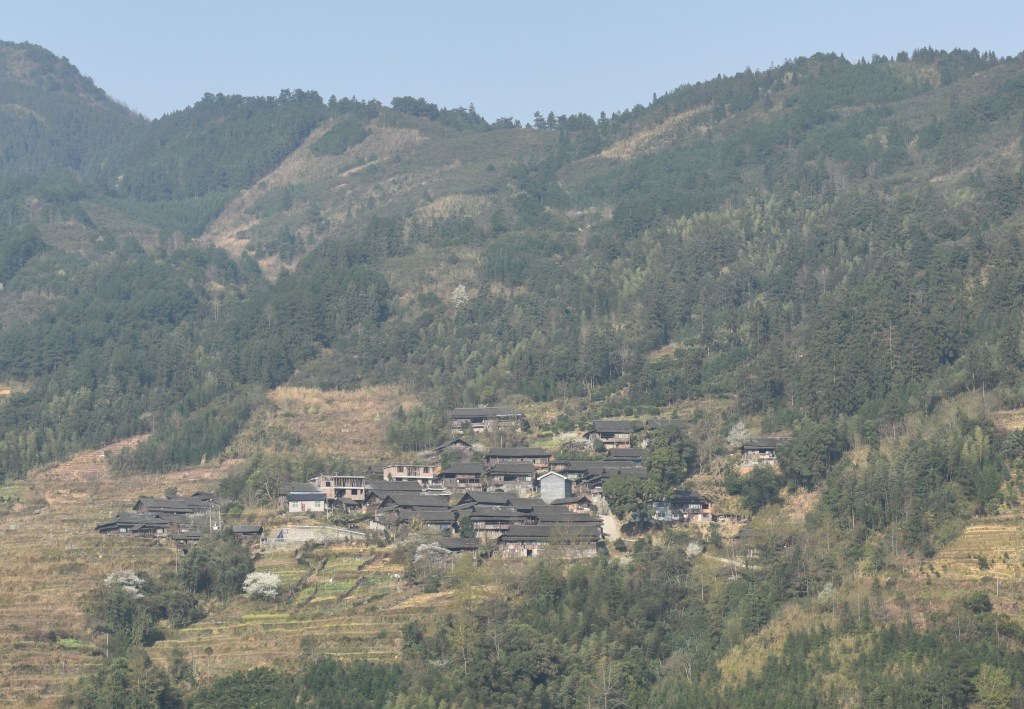
Sanpan Village
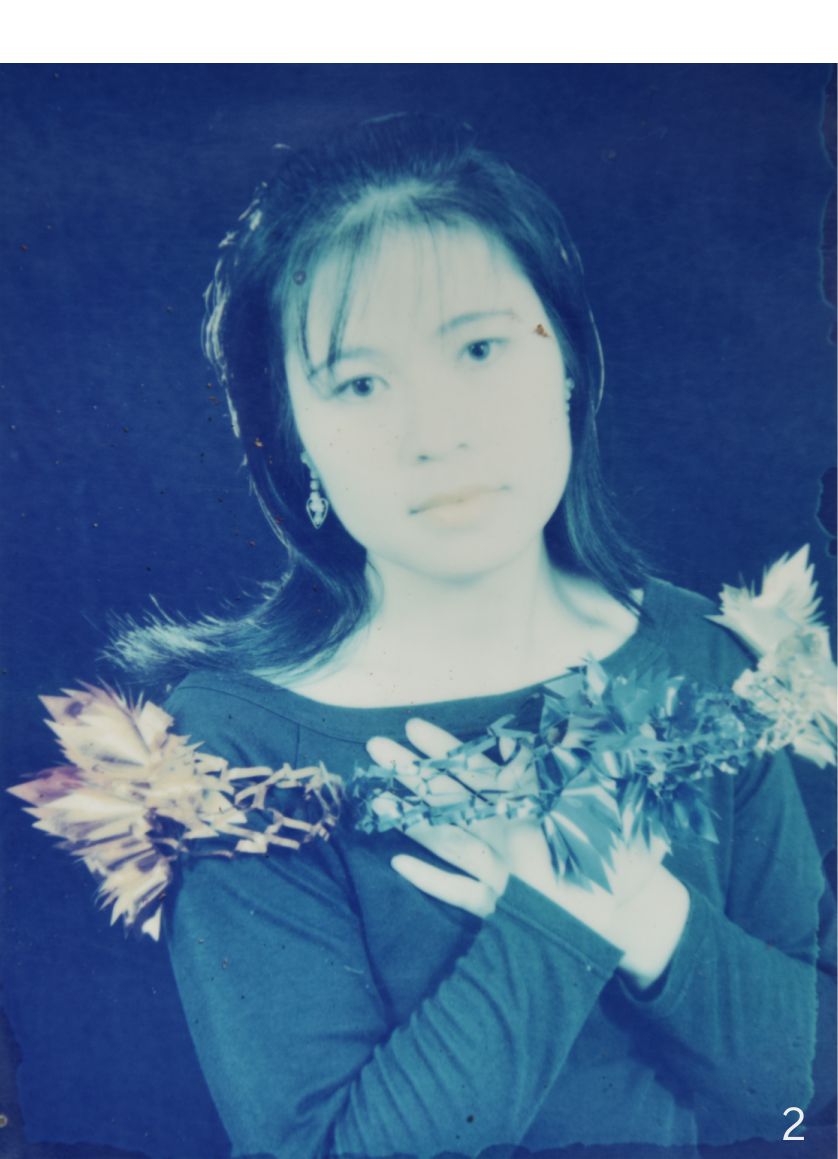
2. Wu Yong’e
Wu Yong’e was born on May 5 , 1973, in Sanpan Village, Pingyangtownship ,Tongdao County. Her father, Wu Xiangde, was born in 1934, and married Huang Changying.
Wu Yong’e emerged from the womb with a significant scar-shaped birthmark on her right shoulder. One day, when Wu Yong’e was two, she heard her mother grumbling about the lack of duck eggs in the house. Sanpan Village is situated halfway up a mountainside, and suffers from both a lack of water and a lack of fishponds suitable for raising ducks. Her mother’s frustration sparked a residual memory in Wu Yong’e, a memory from one of her past lives . She turned to her mother and said, “if there are no duck eggs here, why don’t we go to our home in Diling? They have plenty of duck eggs there!” Shortly thereafter, little Yong’e quickly regained her memory of her past life.
At a little over two years old, Yong’e was not only able to describe her past existence, but also retained the majority of the academic and technical knowledge of her forbear . Despite her age, she was able to recite the Three-Character Classic and other Chinese classics from memory, along with a large number of songs. Raised in a household of illiterates, there was no one to teach her, it was something she was born with. And her knowledge was not limited to the theoretical. Still only two years old, she could treat wounds. Once, while working on the mountain, her mother carelessly cut her hand open. As her mother’s blood flowed, little Yong’e calmly plucked the leaves off some nearby shanyuebao (a local plant) and chewed on them for a timebefore spitting them out and putting them over the wound. Naturally, she also had no problems treating fevers using the herbs that grew wild on the mountain. Her mother could only surmise that Yong’e had been a doctor in her past life.
Still only two, Yong’e demanded that her mother take her to visit her home in Diling, Guangxi. Her mother, unable to win the argument, agreed. Sanpan Village lies on the Hunan side of the Hunan-Guangxi border, and is about 10km from Diling via a mountain road. The Dong people had built Diling into a large walled town of almost a thousand households. After arriving in town , Little Yong’e was quickly able to locate the place she had lived in for 66 years of her past life. The neighborhood had hardly changed, but not a trace remained of her old house. Confused, Yong’e could only ask, “My old house was right here, what could have happened to it?” A crowd soon formed around the girl and her mother, and Yong’e recognized a number of the older men who had come to look on. Calling them by their names, she explained her situation to them. These old men told Yong’e and her mother thatYong’e’s son had moved to another side of town , and showed them the way to his house. But Yong’e was suddenly struck by an inexplicable fever, and by the time she reached her son’s house she was rendered unconscious.
AlthoughYong’e was too ill to speak to her “son,” he was deeply moved when he saw that his father had come back from the dead to visit him. Later that night, he tearfully told Little Yong’e’s mother of the misfortune that had befallen his parents in 1967, at the beginning of the Cultural Revolution.
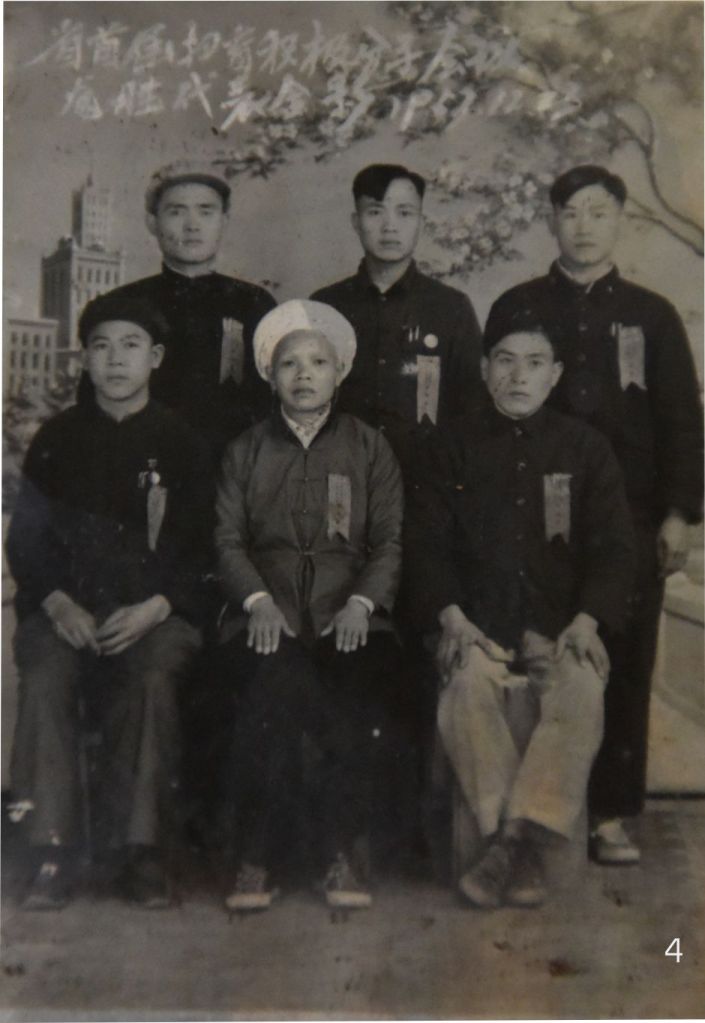
↑4. Wu Fengqin (front-center). Photo of the Longsheng delegation to the Guangxi Provincial Literacy Campaign Activists Meeting. Wu Yunxiu is also pictured (back-right). When his parents were victimized, Wu Yunxiu was teaching in the county capital.
In her past life, Wu Yong’e had been known as Wu Fengqin. Born in 1901, during the Republican era (1912-1949) he had been the mayor of Diling, a famous doctor, and a skilled tailor. While not a landlord, he was well off, a member of the village’s middle class. His wife bore him a son and a daughter. Their son, Wu Yunxiu, taught at a middle school in the county, and the daughter remained by their side. Due to a lack of educated and literate individuals in the village, after liberation Wu Fengqin was assigned to teach villagers how to read. He threw himself into his work tirelessly. Perhaps because of his success, in 1953 he was selected as one of six county-level representatives to the “Guangxi Provincial Literacy Campaign Activists Meeting.” He was well known to the older men of Diling village, who all said that Wu Fengqin had an upright character.
In 1966, as the Cultural Revolution was beginning to spread, Wu Fengqin began to feel increasingly worried. He took the ten or so silver pieces his family possessed and put them in a small jar, which he buried in his vegetable garden.
Not long after this, a few of the Cultural Revolution activists in the village decided to hold a meeting publicly denouncing him. At the meeting, a certain activist, also named Wu (although a different Wu from Wu Fengqin), used a hatchet to slice off Wu Fengqin’s right ear. However, because he used too much force, the axe wound up buried in Wu Fengqin’s right shoulder. This was the origin of Yong’e’s curious birthmark. Afterwards, Wu Fengqin didn’t dare stay in his home, and that night he fled to a small hutch beneath Fengyubridge . His wife would sneak out every day to bring him food. The activists turned the village upside down looking for him, but without success. Frustrated, they seized his wife and began to beat her, telling her she only had a few days to tell them where her husband was hiding. When he heard his wife’s story, Wu Fengqin became even more terrified. He fled further into the mountains, before eventually finding a massive old tree to hide in. When his wife returned home, she was quickly re-arrested and beaten. Refusing to tell the activists where her husband was hiding, she was executed by firing squad. With his wife dead, Wu Fengqin had no one to bring him food, and had no choice but to climb down from the tree and give himself up. In the minds of the activists, Wu Fengqin didn’t merit any special treatment as a doctor. They could prepare their own herbal remedies without him .
Wu Fengqin was bound tightly and dragged off to a field to be shot. Throughout the entire process, his most virulent denouncer had been the aforementioned activist Wu, and it was just this activist Wu who shot him.
According to Wu Yong’e, as he looked down the barrel of the gun that was to kill him, Wu Fengqin did not feel particularly aggrieved. He saw his weeping daughter, but did not cry. Instead, he let out a laugh at himself. Why he did so, he couldn’t say. After watching his body be buried, his ghost quickly found that of his wife, who had died for his sake only three days prior. Their two spirits drifted together towards Fengyu Bridge, at the entrance to Diling, and they came to rest at the top of the famous “River Tree.” His son, then a 42 -year-old teacher still working at the county middle school, knew nothing of what had transpired.
Wu Yong’e can recall her spirit’s life atop that hundred-year-old tree. From its branches, they could observe the whole of Diling Village, and due to its location astride the main entrance to the town, they could clearly see everyone’s comings and goings. The two ghosts, husband and wife, sat atop the tree and discussed what they wanted from their next lives. Wu Fengqin said, “this is a bad place, I don’t want to be reborn here, I want to go somewhere far away…And there’s too much responsibility involved in being a man, every time something happens you get dragged out and beaten, in my next life I want to be a woman.” And his wife, Ms. Liang, replied, “I don’t want to go anywhere, and I want to be reborn a man. All I want from my next life is revenge!” Unexpectedly, their wishes in the matter would come true.
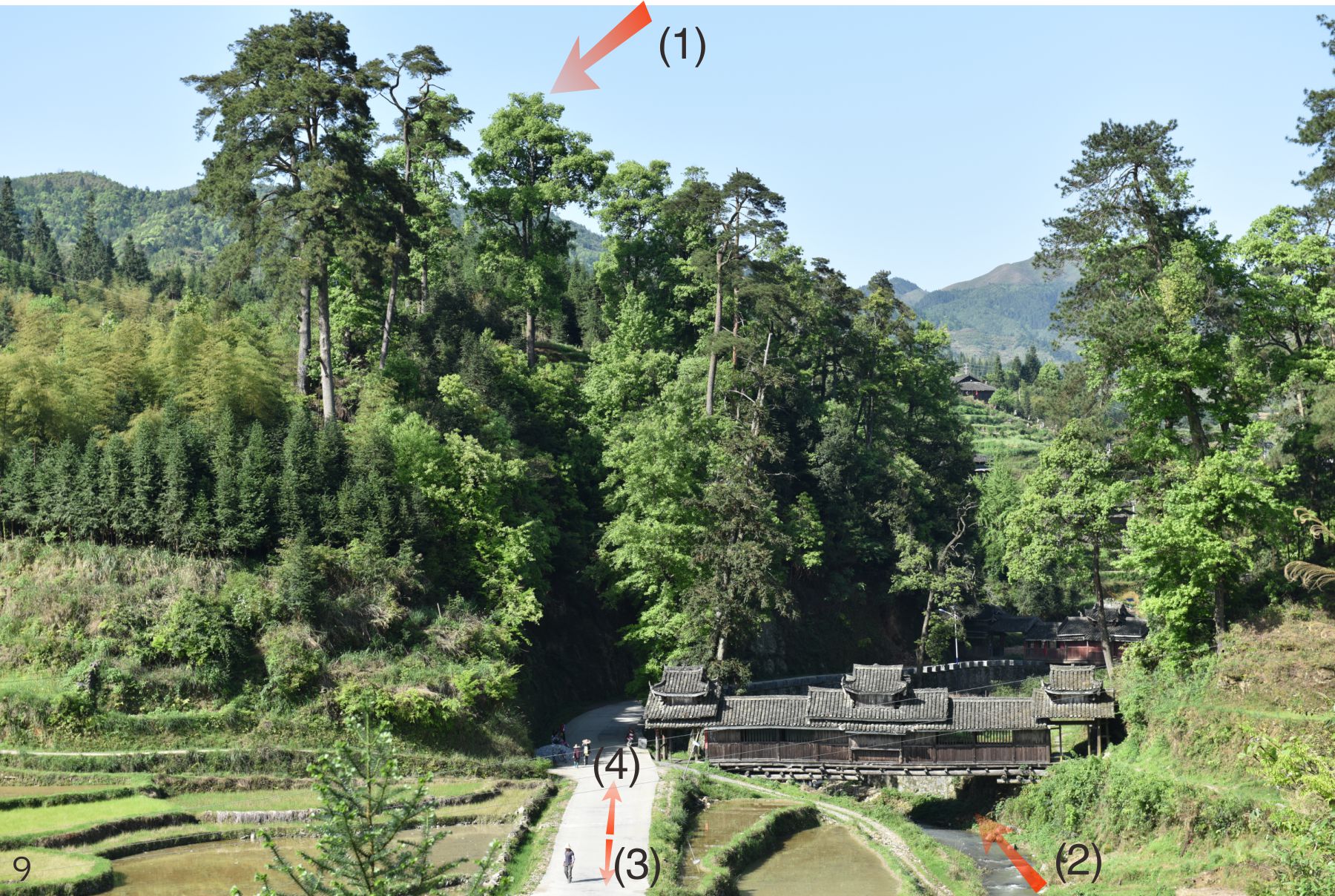
9. (1) The “River Tree,” where the two souls waited to reincarnate.(2) Hiding place. (3) Sanpan Village. (4) Diling Village.
Fengyu Bridge, at the entrance to Diling. After their deaths, the souls of Wu Fengqin and his wife lived atop the large tree to the left for several months, where they had a bird’s-eye view of the entire village. It was from this vantage point that Wu Fengqin first saw a woman from Sanpan village, who had come to town to buy duck eggs and decided to be reincarnated with her. You can also see the place under the bridge where Wu Fengqin hid for 17 days.
The two of them were killed in 1967, and lived together atop the tree until May 1970. It was then that Wu Fengqin saw a middle-aged woman, carrying a basket on her back, enter the village. She was tall and thin, with a nice figure, and had a dignified air about her. He turned to his wife’s ghost and said, “This person doesn’t look so bad, I’ll go with her to be reborn.” And so their two souls were separated.
The woman Wu Fengqin had seen was Wu Yong’e’s maternal grandmother, Ms. Wang . Her daughter had just given birth to a child, and she had come to Guangxi to buy some duck eggs for the new mother’s post-natal recovery.
Wu Fengqin descended from the tree and followed his future grandmother as she bought duck eggs. Together they returned to his new home in Sanpan village. Throughout their journey, whenever they had to climb uphill, Wu Fengqin would jump into his grandmother’s basket, and jumped out when there was a dip in the road. Wu Yong’e remembers feeling too weak to climb the mountains, but not knowing why, so she would climb into her grandmother’s basket. When she returned with her duck eggs to Sanpan Village, Ms. Huang told her daughter, “It’s very strange! Whenever I walked uphill, the basket suddenly seemed to get much heavier, but I’m sure its contents never changed.”
When Wu Fengqin’s spirit arrived at its new home, it took up residence behind the bedroom door. But his future mother failed to respect the Dong tradition: “when there is a pregnant woman at home, don’t clean behind the door.” So nearly every day Wu Fengqin was whacked by the woman’s bamboo broom, and his legs and feet hurt horribly. He said to himself, “If I’m just going to suffer here, I may as well come out and be reborn.” So he emerged from behind the door and was reborn as the woman’s fourth, and smallest , child.
Little Yong’e was one of those reincarnates whose memory suffered no damage. From when she was two until she was four, she could recount all kinds of details from her past life. This caused her mother no small amount of concern, especially after Yong’e came down with the high fever while visiting her old home. After they returned home, she strictly forbade her daughter from discussing her past life, but it was useless to try and reason with her. So she began searching the village for a red carp, with which she could make a soup that would cause her daughter to forget the horrors of the past.
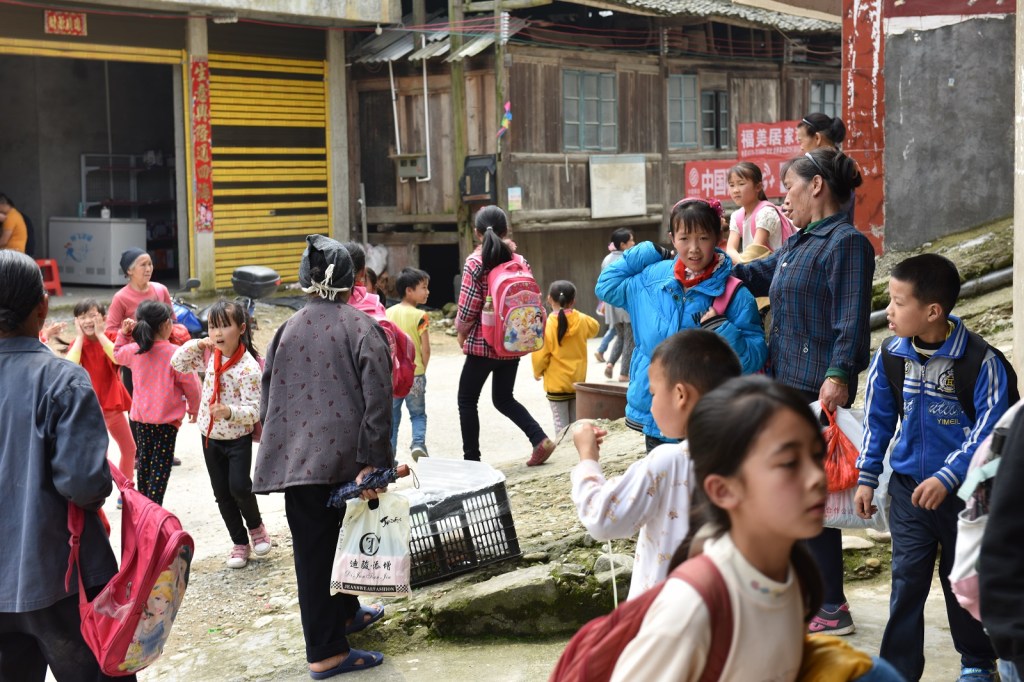
↑ The main street of Diling Village
When Yong’e was three, she was playing in the street when she recognized a man ferrying lumber from Diling to Sanpan Village . This man was no old friend, he was the very same activist Wu who had killed Wu Fengqin three years prior. Overcome with rage, little Yong’e trailed after her enemy, hurling abuse at him. Her words were half curses, half shouts. “I am Wu Fengqin, in my last life you killed me, and now I will beat you to death!” Activist Wu immediately went white with fear. Shortly after returning to Diling he came down with a mental illness, and a few years later he was dead. Was this karma at work?
Wu Yong’e says that before she was five she could almost entirely remember her previous life. It was as if she had never died, only switched bodies with a child when she was 66 years old. But after she had drunk large amounts of the red carp soup her mother had made her, she began to lose her memories. She was six when they began to fade. When she was seven, her son Wu Yunxiu came to Sanpan Village to pay his respects to his “father.” When he arrived, however, Yong’e’s mother treated him like an unwanted guest, spiriting her daughter to a neighbor’s house to live for a few days. Wu Yunxiu stayed for two nights without so much as glimpsing his “father” before returning home in a rage.
After his death, Wu Fengqin certainly spent time in the nether realm. It was a judge there that, considering his wishes, had him reincarnated exactly as he hoped (along with his wife). When Wu Yunxiu next returned to Sanpan Village, he finally saw his father’s reincarnation, the then 9-year-old Wu Yong’e, who was about to begin elementary school. He was overcome with emotion, and afterwards the two sides reconciled.
Upon graduating from primary school at the age of 15, Wu Yong’e began taking night classes. Wu Yunxiuwould often write her letters, warning her that if she grew up without acquiring any culture, her prospects would be dim, and encouraging her at her studies. In 1990, at the age of 17, her mother permitted Wu Yong’e to accompany two girls from the village to visit her family in Diling, provided she promised not to discuss her prior life while there. It had already been 15 years since her first and only visit.
When the three girls arrived at the home of Wu Yunxiu, they were welcomed enthusiastically. Still, when Wu Yunxiu referred to Wu Yong’e as “father,” she wasted no time in hushing him. “If you keep calling me that, I won’t dare come back. My mother only allowed me to come this time after I promised not to discuss my past life with you.” She had no objections to Wu Yunxiu’s children referring to her as grandfather, however, a habit that they maintain even now (a female grandfather!).
As Wu Yong’e remembers it, on her second visit to Diling the endless stream of visitors was reminiscent of a bridal shower (a spectacle perhaps explained by Wu Fengqin’s fame in the town). Especially numerous were close friends and old acquaintances of Wu Fengqin, who all wanted to ask the same question: “Hey, we used to have a lot of fun together, do you still remember me?”
Alas, at 17 Wu Yong’e’s memory was not what it used to be, and while their faces felt familiar, she found she couldn’t remember their names. There were a few whose names she remembered, but with her mother’s orders in mind she didn’t dare speak with them. And so, in response to every question of this kind she simply said, “of course, of course, but my mother forbade me from talking about my past life.” Her old friends were greatly pleased with this, saying, “as long as she recognizes me, it’s no matter whether we can speak or not.” After sitting a while, they left happily.
But no sooner had these guests gone that another group entered the room. Diling is a village of over 1000 familes, spread out over a great distance, so the news of Wu Yong’e’s arrival did not reach the ears of an important family until evening on the second day. This family, of course, was that of Wu Fengqin’s wife, who had preceded him into the other world by only three days.
After the two souls had separated from one another by the tree at Diling’s gate, Wu Fengqin had gone to Sanpan Village, where he lived for more than two years behind the door before being reborn as Wu Yong’e in 1973. His wife, on the other hand, had fulfilled her dream two years earlier, being reborn as a boy in Diling by the name of Wu Xiongmin. Wu Xiongmin had also not forgotten the vow of revenge he had taken as a spirit, and struck his first blow at the age of two.
Wu Xiongmin, like Wu Yong’e, began to discuss his past life when he was two years old. It did not take long for his identity to be confirmed as that of Ms. Liang, who had been the subject of such injustice three years prior. One day, as Wu Xiongmin accompanied his mother, they chanced by a house with a young man sitting in front, honing a knife. Upon seeing the young man, who also had the surname Wu, little Xiongmin fixed him with a deathly stare, recognizing him as the very enemy who had hounded and killed him in his past life. Suddenly, Xiongminbounded forward, and, still staring at the young man without a drop of fear in his eyes, shouted, “You’re the one who killed me in my past life ! ” Xiongmin kept staring at the man and repeating this one sentence over and over when, suddenly realizing who the child was, this young Wu went deathly pale. Unable to form words, he shot up and tried to leave. But little Xiongmin was not one to let his prey escape, and he followed the man, still shouting this one sentence: “You’re the one who killed me in my past life ! They had not gone far when this young Wu began to break down and quickly descended into madness. He remained in this state for several decades until he finally reached his tragic end only a few years ago.
A husband and wife, who remembered their enemies, even in their reincarnations, and who hounded them to madness and death with nothing more than their words, is not a story one hears every day.
On her third day in Diling Village, Wu Yong’e received a particularly excited visitor, who told her that Wu Xiongmin planned to visit her that very morning. Not only this, but the visitor also wanted to play matchmaker between the two, in the hopes Wu Yong’e would agree to marry Wu Xiongmin. He said they were of an age, and would make an excellent match, continuing the love of their past lives into the future. Such pronouncements had a profound effect on a girl who had grown up in a very traditional, conservative village, and Wu Yong’e found herself flushing red. The three girls hurriedly ate breakfast before just as hurriedly saying their farewells to Wu Yunxiu. They jogged the whole way out of Diling. Just before leaving, Wu Yong’e’s daughter in law gave each of the three girls a red envelope with 50 yuan inside. In 1990, to give such an amount of money was a grand gesture, indeed.
When Wu Yong’e was 23, she married a certain man by the name of Yang from Enke Village in Ganxi. Wu Yunxiu gave her a magnificent trousseau. As Yunxiu grew older, Wu Yong’e would visit him in Longsheng every year. On December 22 , 2008 (of the lunar calendar), Longsheng saw its first snow in decades, on the very day Yong’e went to visit Yunxiu. By this time, Yunxiu, already over eighty years old, had lived in the county retirement home for a number of years. As Yunxiu told Yong’e when she arrived, “I’m old and can no longer move, it’s best I have someone to take care of me.” The retirement home was typically staffed by a single nurse, who had to care for multiple residents. How were these nurses, who themselves were rarely young, supposed to care for several elderly individuals? Just before Yong’e left, Wu Yunxiu clasped the hand of his “father” and said, “My birthday is on the eighth day of the new year, only two weeks hence. You must bring your family to visit!” Who could have guessed that this farewell would be their last? That night Wu Yunxiu passed away. He left behind a son, Wu Guangshan, who also worked in Longsheng.
In July, 2010 the current incarnations of the husband and wife who had suffered so much in those three days in 1967, Wu Yong’e and Wu Xiongmin, met for the first time in a restaurant in Longsheng. Wu Yong’e was by this time 37 years old, and was accompanied by her husband and daughter. Wu Xiongmin, two years her elder at 39, came with his wife. They chatted about anything and everything, though said very little about their previous lives, perhaps because the topic was still a source of pain and suffering for them, one they were unwilling to broach in the context of a family reunion. Wu Xiongmin’s wife was an exceptionally humorous woman, one who gave her love of jokes full rein at the table. One crack left the whole table suspended between laughter and tears. “You two made quite a couple in your past lives, and now husband has become wife, wife become husband. What do you think, how about we do a little reshuffling? I’ll go home with Yong’e’s husband, and you two can stay together.” Upon hearing her words, the whole table burst into laughter. Adding to the intrigue, Wu Yong’e’s own daughter, Yang Qiucan, born in 2003, had been reincarnated. In her past life she had been a girl in Enke village. Moreover, Wu Xiongmin’s daughter was also a reincarnation, though the details of her past life were unclear.
After a ninety minute interview, Wu Yong’e had to leave for her night job. She was open about the difficulties she faced in this life. Her mortgage still had more than 100,000 yuan left on it, and with two children in school her expenses were high. Her daughter was a student at the county No. 4 Middle School and ranked in the top twenty out of a class of four hundred. With these relatively good grades, Wu Yong’e had to consider the future expenses of sending her to university (she wouldn’t consider not helping her daughter with this). In the county seat, however, a normal worker couldn’t hope to make more than 1,500 yuan a month, and even with two jobs Wu Yong’e was only able to make a bit more than 2,000 a month. At night she worked as a cleaner for a KTV parlor, from seven until after one. During the day she had another job with a different company. Never able to get enough sleep, her life was a full of struggles. Her husband worked in construction, which itself was hardly remunerative.
Conversely, her former wife, Wu Xiongmin, had served in the army for a number of years, before eventually transferring to China Mobile, a state owned monopoly. His salary was quite good, and he owned a house with multiple rooms in the county seat. When I asked Wu Yong’e why she doesn’t ask her former “wife” for help, she quickly rebuked me. “I’m not that kind of person! And anyway, we each have our own families in this life.”
Wu Yong’e says that when Wu Yunxiu was still alive, he would often tell her how much her attitude and character reminded him of his father, and especially her eyebrows, which were exactly the same as his fathers. Wu Yunxiu’s strong emotional attachment to Wu Yong’e can be seen from the photos he hung in his living room, including two pictures of Wu Yong’e when she was two years old, which he placed in the most prominent position (it must be said that Wu Yong’e was exceptionally beautiful when she was a young girl). But Wu Yunxiu’s filial love was not limited to this young girl from SanpanVillage, he also found another reincarnation of his father’s soul in a young boy in Pingtan Village . In point of fact, Wu Fengqin had originally possessed two souls, one of which had been reborn in a young girl in Sanpan Village, the other of which had been reborn in a young boy in Pingtan. When she was younger, Wu Yong’e had remarked on this to her mother “I [Wu Fengqin] have another soul. He went to Gaotuan to be reborn.” As the story goes, when Wu Yunxiu passed a young boy in Pingtan, the child clutched his arm and said, “Yunxiu! I’m your father Wu Fengqin!” Wu Yunxiu was certainly shocked, as he had already met his father’s reincarnation in Yong’e. How did he come to have a second father here? He tested the child thoroughly before realizing he was telling the truth. His father’s body had once held two souls, both of which had reincarnated, and both of which could still remember their past life!
The child, a boy of seven or eight, was just as furious at the man who had killed him as Yong’e had been, and demanded his “son” take him back to Diling so he could avenge himself. Wu Yunxiu was frightened, and didn’t dare bring the child back with him. Instead, he asked the child where he lived before leaving. After arriving back in Diling, Wu Yunxiu was worried that bringing his father back could cause trouble, and didn’t dare return to Pingtan to speak with the boy. It was only 10 or so years later that he returned to Pingtan and spent two days searching for his father’s other soul. He had no luck, however, and could not find out where the child had gone.
Alas, Wu Yunxiu passed away in 2008. I learned of this story from his son, Wu Guangshan, and confirmed it with both village elders and Wu Yong’e. Although when she was young Wu Yong’e declared the reincarnation would be found in Gaotuan and not Pingtan, in actuality Gaotuan, Pingtan, and the village of Yanglan form a sort of rough triangle, and all are within two kilometers of each other. When I first heard the story I was quite excited, and asked old Yao, a local who was very familiar with the area, to guide me while I searched for the boy. I looked all day without success. While the truth of the matter was never in doubt, much time has already passed. If the boy is still alive, he would have been born after 1973, putting him in his forties today. If anyone were to find him, it would have the same impact on the study of the soul as would the discovery of a new element in chemistry!
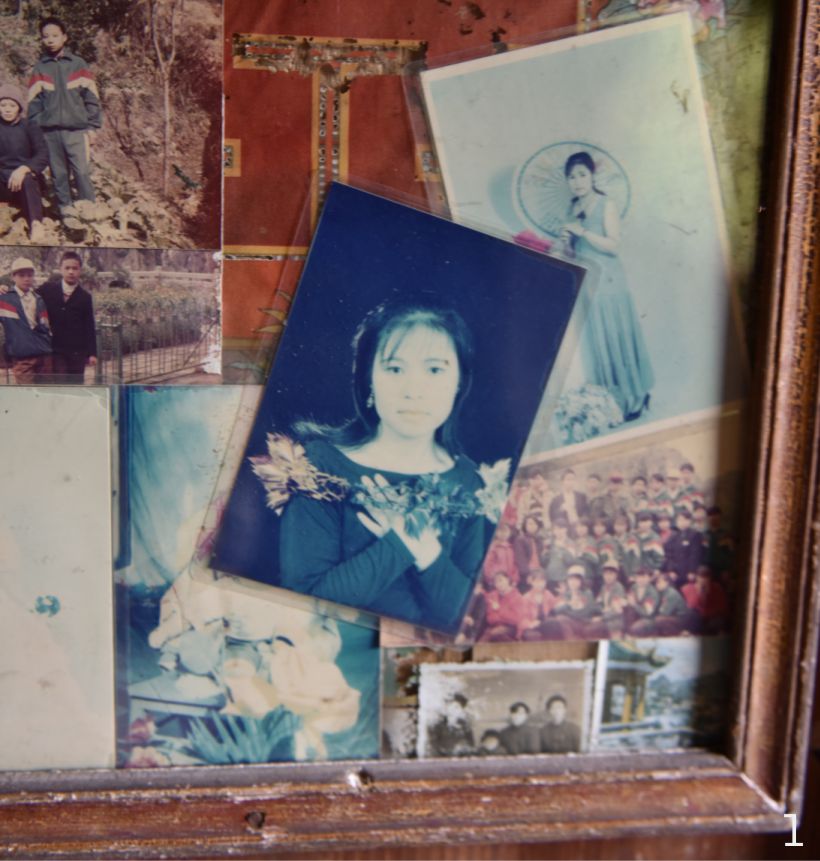
1. Wu Fengqin’s son Wu Yunxiu placed Wu Yong’e’s photo in the center of his display case. The two of them communicated often, and grew very close.
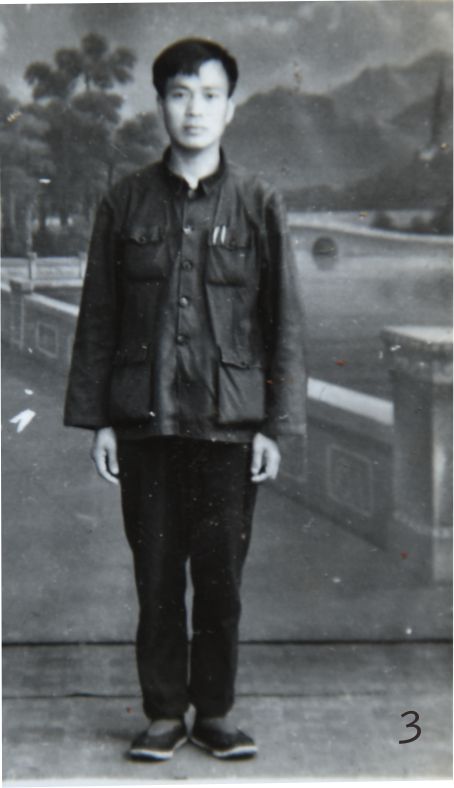
3. Wu Yunxiu (picture taken in the 1950s)
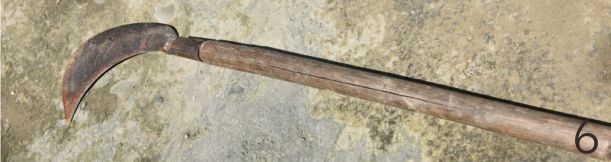
5. Wu Fengqin lost his ear to this type of axe.
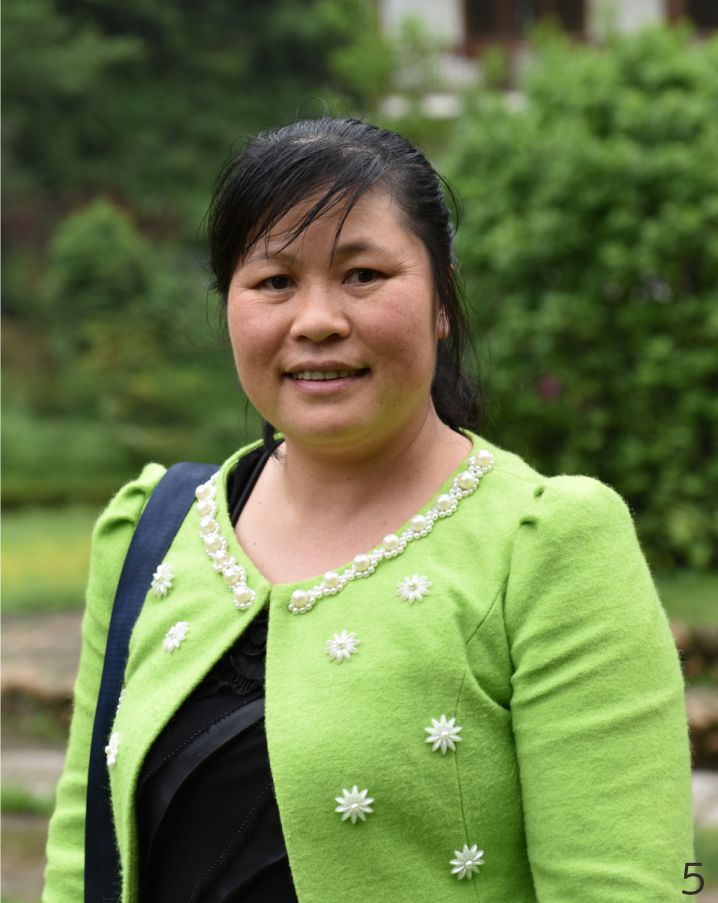
6. A recent photo of Wu Yong’e. At the age of two, Wu Yong’e declared, “I have another soul, which went to Gaotuan (Pingtan Village ) to be reborn.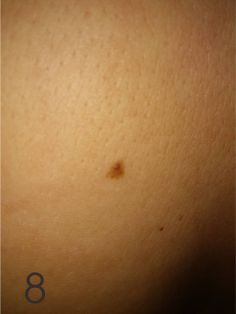
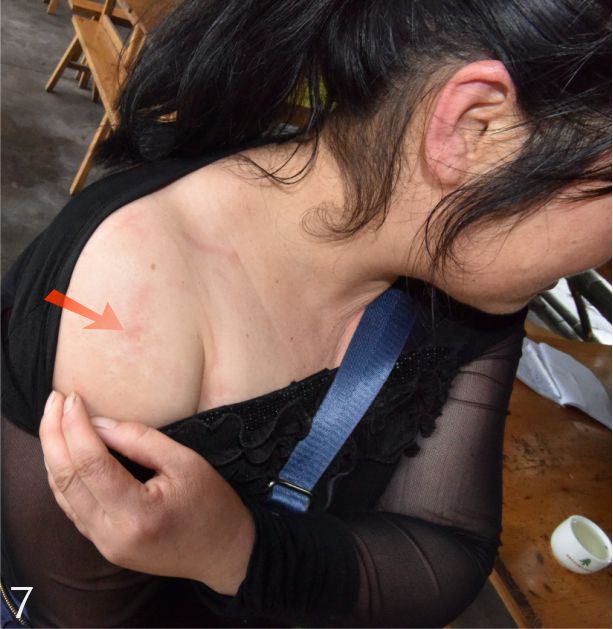
7. A birthmark on Wu Yong’e’s back, where the bullet left Wu Fengqin’s body.
8 + 9. In 1967, at the height of the Cultural Revolution, a certain Wu used an axe to cleave Wu Fengqin’s ear from his body. The force of his blow was such that it cut into Wu Fengqin’s shoulder. 20 days later, he was killed. He carried the wound over into this life.
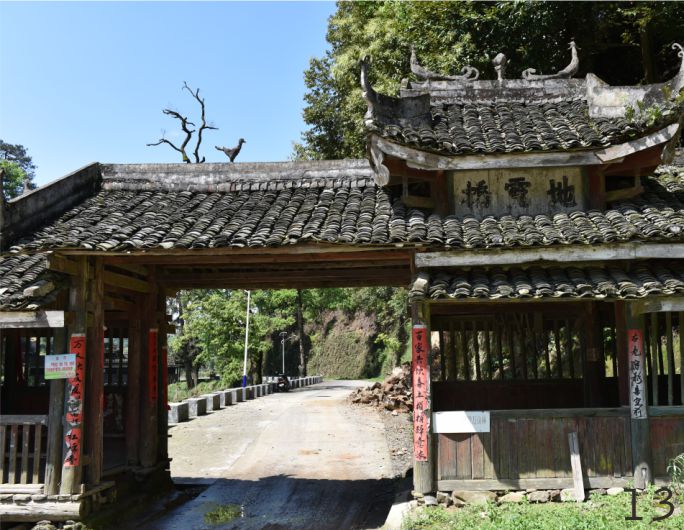
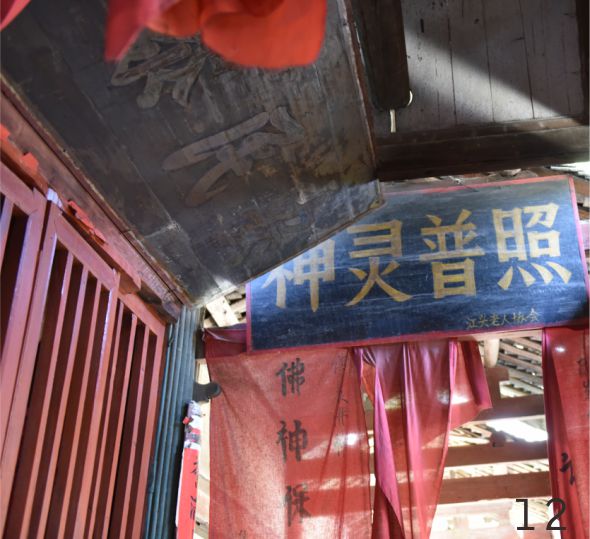
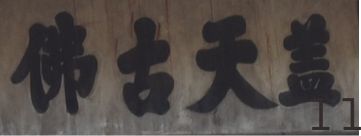
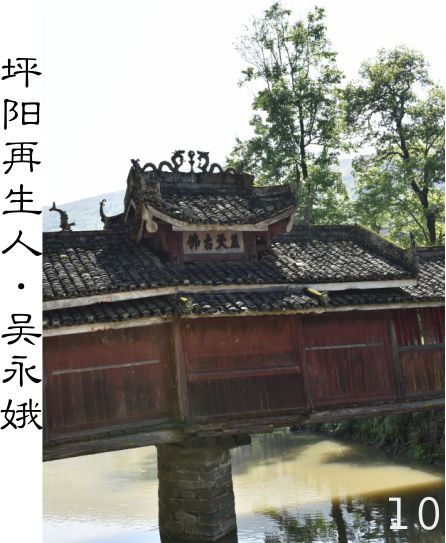
11+12+13. Fengyu Bridge is rich with local religious artifacts. The local traditions include veneration of Buddhist, Daoist, and local deities.
14. In the center of the bridge there is a temple to Buddha and the bodhisattva Guanyin. “The Divine Illuminates all Things,” proclaims a banner within.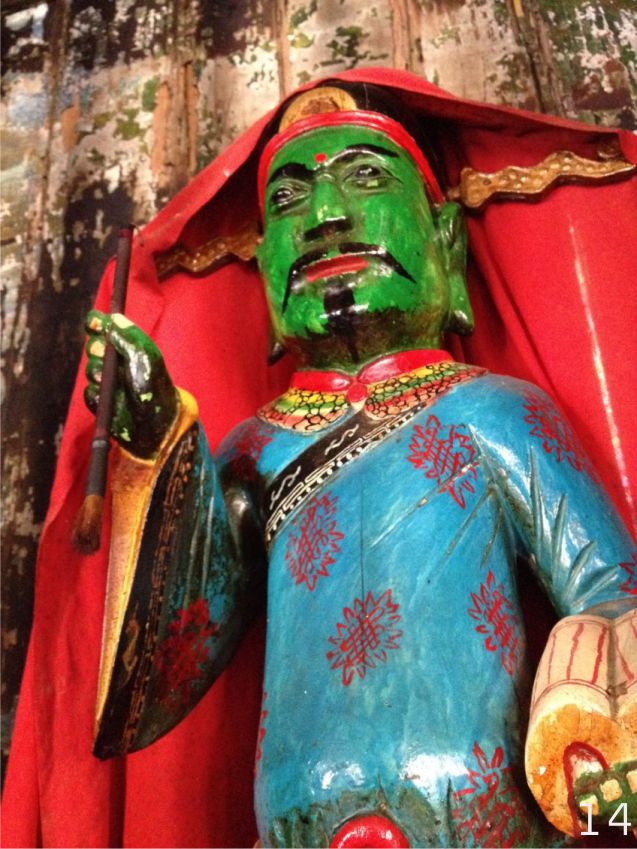
15. The most interior shrine on Fengyu Bridge is dedicated to the green-faced, blue-robed Panguan, a deity that judges souls. In his right hand, he clutches the “Quill of Enchantment; in his left the “Book of Life and Death.” He has the power to alter the fate of any person at any time, and is responsible for rewarding the virtuous and punishing the wicked. In China, it is widely believed that good and evil deeds are recorded on the soul, and each will be judged in kind.
16. At one end of the bridge, there is a shrine to Grandfather and Grandmother Earth, who are the local protector deities. They are placed over the intersection of the bridge and village.
17+18. The central section of the bridge also contains a shrine to Guan Yu (center). Next to him are his aides: Zhou Cang (left) and Guan Ping (Right). They represent loyalty and righteousness, and Guan Yu is also a protector of China.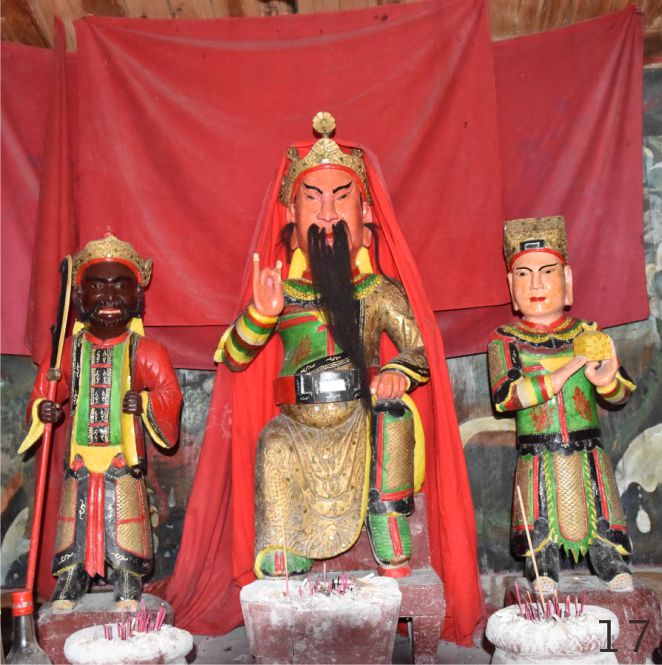
19. Wu Fengqin’s grandson, Wu Guangshan, stands in front of his father’s (Wu Yunxiu’s) house.
Wu Yong’e’s own daughter, Yang Qiucan, born in 2003, had been reincarnated. In her past life she had been a girl in Enke village.
Case #22. Qiucan Yang(Yong’e Wu’s daughter)
Qiucan Yang was born in 2003 in the village of Enke. Her mother was Yong’e Wu.
When Qiucan was a year and eight months old, she began to talk about her past life as a hunchbacked woman from the same village with the last name Yang, as well details about the lives of Yang’s parents and her three siblings. Yang and Qiucan’s mother Yong’e came from the same district of the same village, and their homes were quite close to each other. Due to the spinal deformity that had afflicted her from birth, Yang stood at just 3’3’’ in height. During her lifetime, she shared a very close bond with Qiucan’s mother Yong’e, whose husband often travelled for work. Yong’e felt a little intimidated caring for her son at home all alone, so Yang often visited and lived with Yong’e, occasionally for more than ten days at a time.
Yang was born in 1980. She was afflicted with an illness when she was 21, and spent the next half a year confined to her bed until she passed away. During this time, Yong’e visited and took care of her very often.
A year after Yang had passed away, Yong’e became pregnant with child.
Before she gave birth, Yong’e had a dream in which she saw Yang standing hunchbacked in front of her house, in the middle of the cement grounds used for drying harvested grains. She asked, “What are you doing here, Yang?” And Yang replied with a smile, “Just a little longer now, then I will be seeing you at home.” After awakening from her dream, Yong’e began to go into labor, and her daughter was born soon after.
During the festive seasons, Yang’s reincarnation Qiucan would get her parents to prepare gifts for her old family, and deliver them herself to the parents from her past life. In return, her parents would also give her a traditional red pocket with their blessings during the Spring Festival.
Qiucan is currently attending the second year of her junior high (eighth grade). She is excelling academically, and has a talent for dancing.
Qiucan Yang’s favorite hobby is dancing! Her mom sent her video to me and agrees to publish here.

 Changzhen Li's Books 李常珍开发的儿童中英文教材和其它个人作品
为 100 Cases of Reincarnation Among Dong People – Changzhen Li's Books 李常珍开发的儿童中文汉语教材和其他作品 发表评论 取消回复